








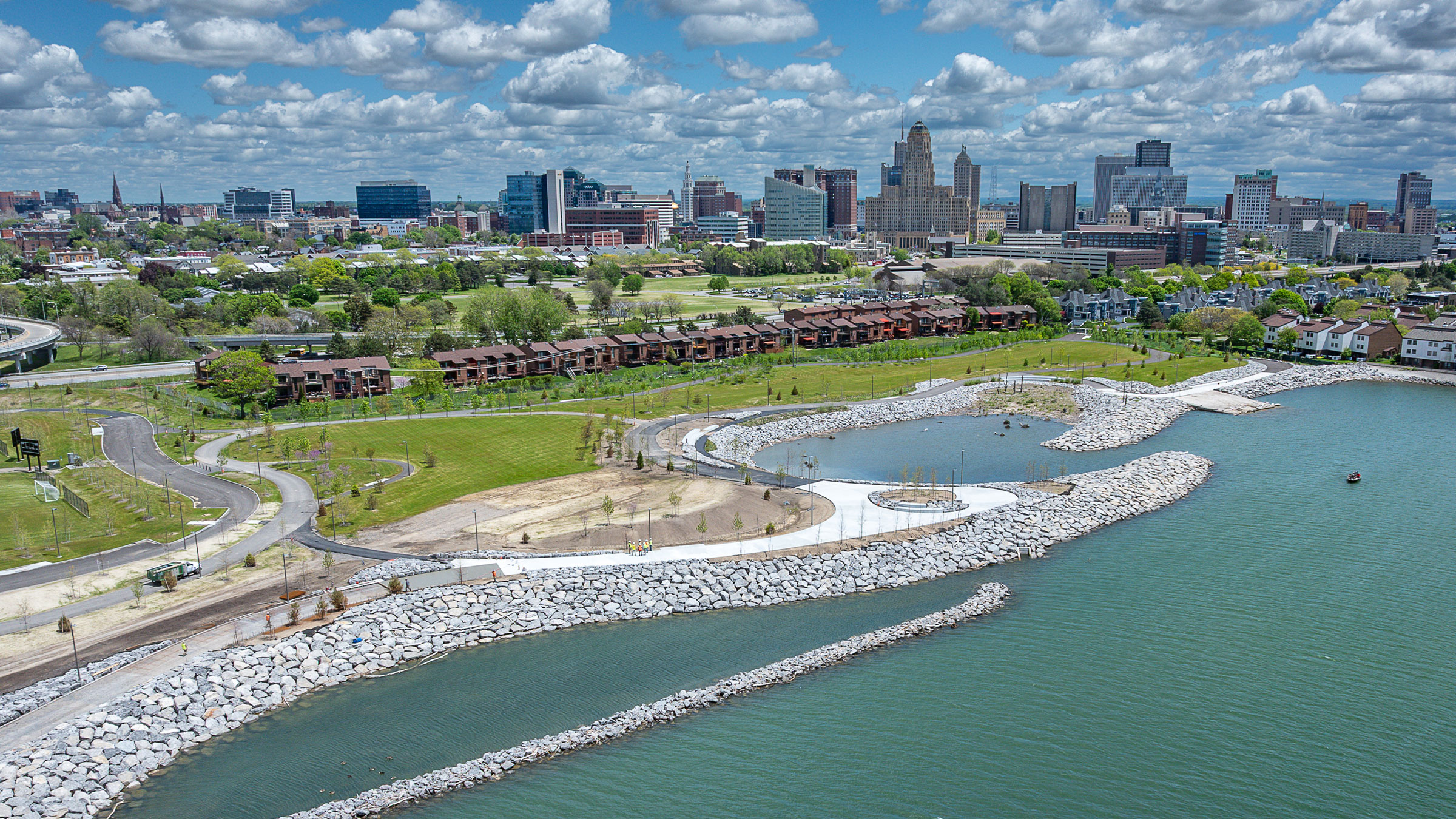
For a century, the edge of what’s now Ralph Wilson Park was defined by a stark, vertical, artificial wall built to hold back Lake Erie. Long known as LaSalle Park or Centennial Park, the site officially became City of Buffalo parkland in the 1930s (having previously served as a municipal dumping ground), yet the wall and nearby I-190 kept local residents cut off from the water. Dating back to the 1920s and ’30s, the wall had long outlived its purpose, slowly crumbling under decades of pounding waves, ice, and storm surges.
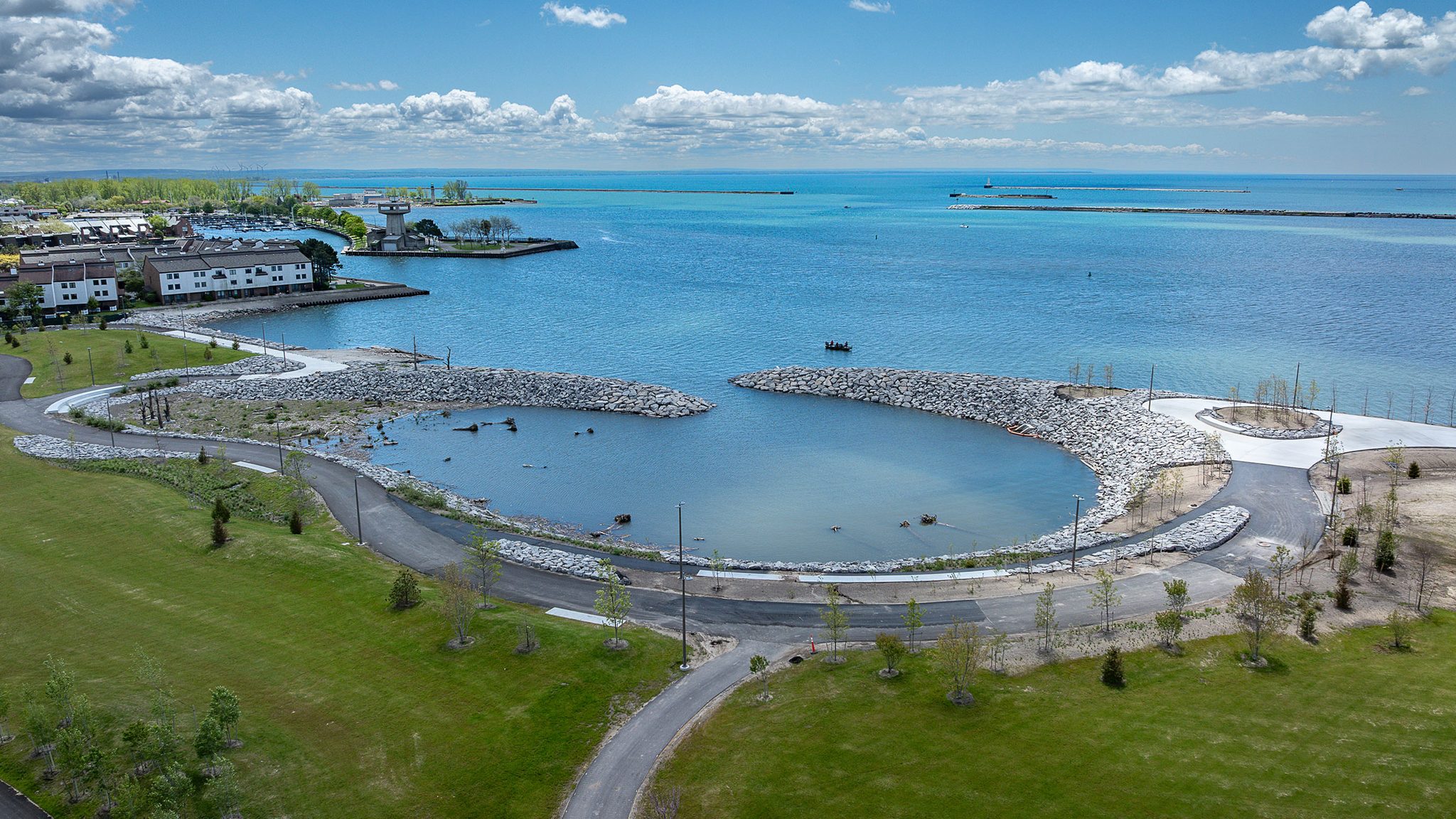
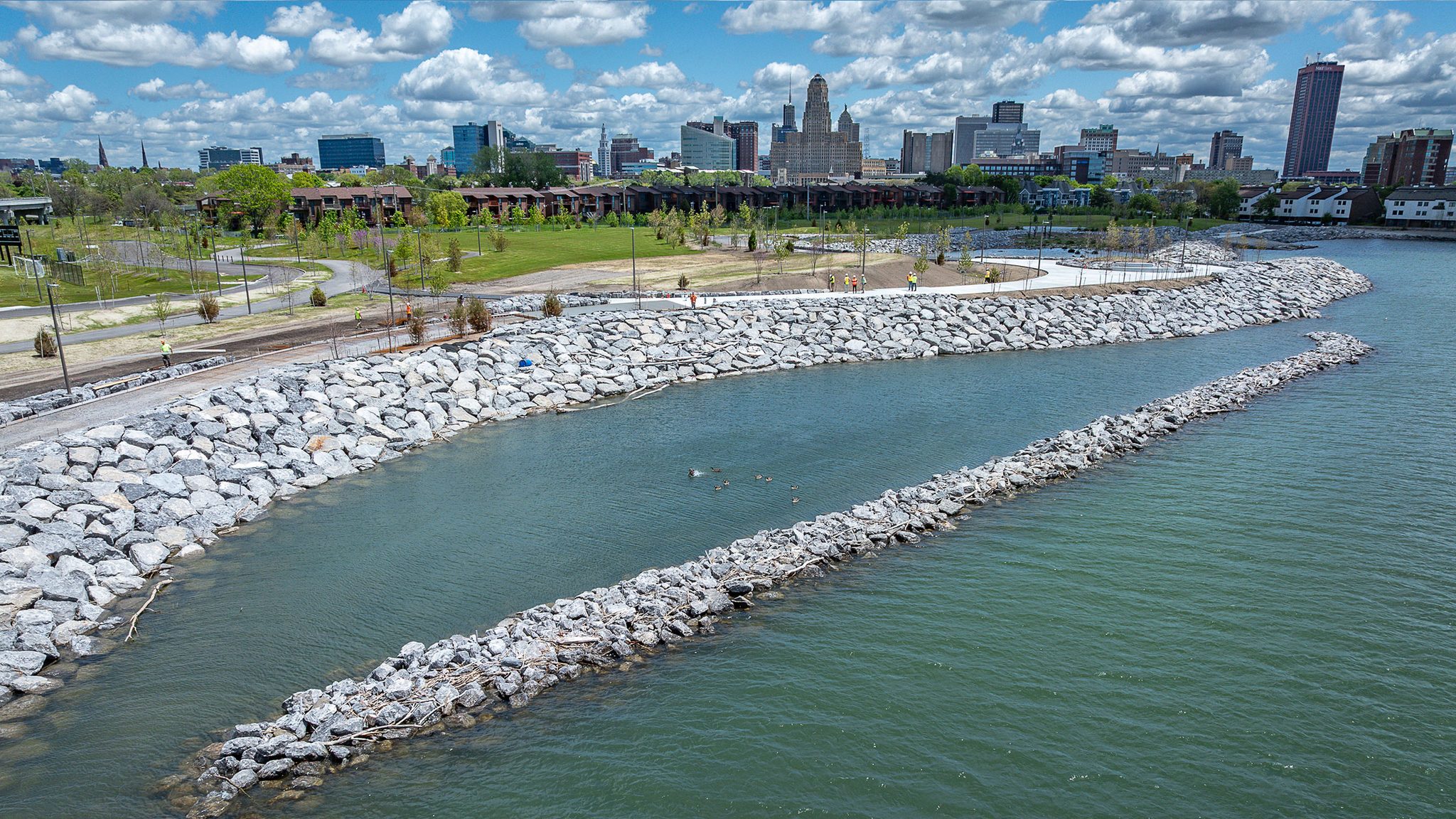
Today, that wall is gone. In its place lies a gently curving, natural shoreline and a calm inlet, sheltered from the open lake. Herons, ducks, geese, and native fish are already showing up, drawn to the new wetland plants along the water’s edge. As one of the centerpiece projects of the park’s redevelopment, this shoreline transformation simply started with a few people willing to walk out onto a crumbling wall on a cold November day.
A Cold Walk and a Turning Point
Initially, the project began with a major philanthropic investment from the Ralph C. Wilson, Jr. Foundation in Western New York, which anchored the effort in community-driven design. To ensure local voices guided the vision, the community engagement group Imagine LaSalle was formed to define the new park’s priorities. When landscape architecture firm Michael Van Valkenburgh Associates (MVVA) – creators of a sister waterfront park in Detroit – pitched their approach directly to the Imagine LaSalle group, it was that community-first vision that ultimately won them the design commission.
Once the park’s initial design and funding were in place, Buffalo Niagara Waterkeeper raised a critical concern that changed the shoreline’s fate. Without a full redesign of the deteriorating seawall, the new park would be severely vulnerable to flooding, putting the entire investment at risk. For decades, routine severe weather made key areas unusable, forcing community leaders and youth sports leagues to battle mud and flooded fields every season.
As Madeline Taylor-Rodriguez, president of the Westside Ponytail Softball Baseball League, recalls: “Our busy baseball days began at the T-ball diamonds, which were never accessible when it rained. We used to have to keep dirt and rocks on hand just to fill home plate. In 2022, when we played on those diamonds, you could clearly see the damage winter had caused to the grass, as well as the lingering effects of the debris.”
Waterkeeper Executive Director Jill Jedlicka and Deputy Executive Director Kerrie Gallo walked the crumbling wall with state biologists on a freezing November day to make their case. That walk helped the Waterkeeper secure approximately $13 million in National Oceanic and Atmospheric Administration (NOAA) funding through the Great Lakes Commission, part of the Great Lakes Restoration Initiative, along with several other federal and state grants totaling $29 million to redesign the shoreline entirely as a coastal resiliency project. The effort also aligned with the Waterkeeper’s mission to reconnect people with the water, including constructing a “Buffalo Blueway” site for safe kayak and canoe access.
Because the site sits within the federally designated Niagara River Area of Concern, one of the most degraded stretches of shoreline in the Great Lakes system, the Waterkeeper’s efforts to redesign the shoreline and enhance habitat will protect the park while helping to eventually remove the river off of the Area of Concern list for good.
Uncharted Waters: Reimagining Lake Erie’s Edge
Designing a coastal resiliency project on a Great Lake presents unique challenges, as strong winds, fluctuating water levels, seasonal ice, and powerful storms put constant pressure on shoreline infrastructure. Rather than simply replacing the aging seawall with another hard barrier, Ralph Wilson Park is taking a less common approach on the Great Lakes, combining engineered protection with a naturalized shoreline that could serve as a case study for future coastal resiliency projects.
During design, Paloma Garcia, associate principal at Michael Van Valkenburgh Associates (MVVA), assembled a team of roughly 14 consultants, including hydrologists, ecologists, and marine engineers. Using modeling to test different lake conditions and design scenarios, the team identified the optimal shoreline footprint and materials to withstand Lake Erie’s forces while maintaining a stable inlet.
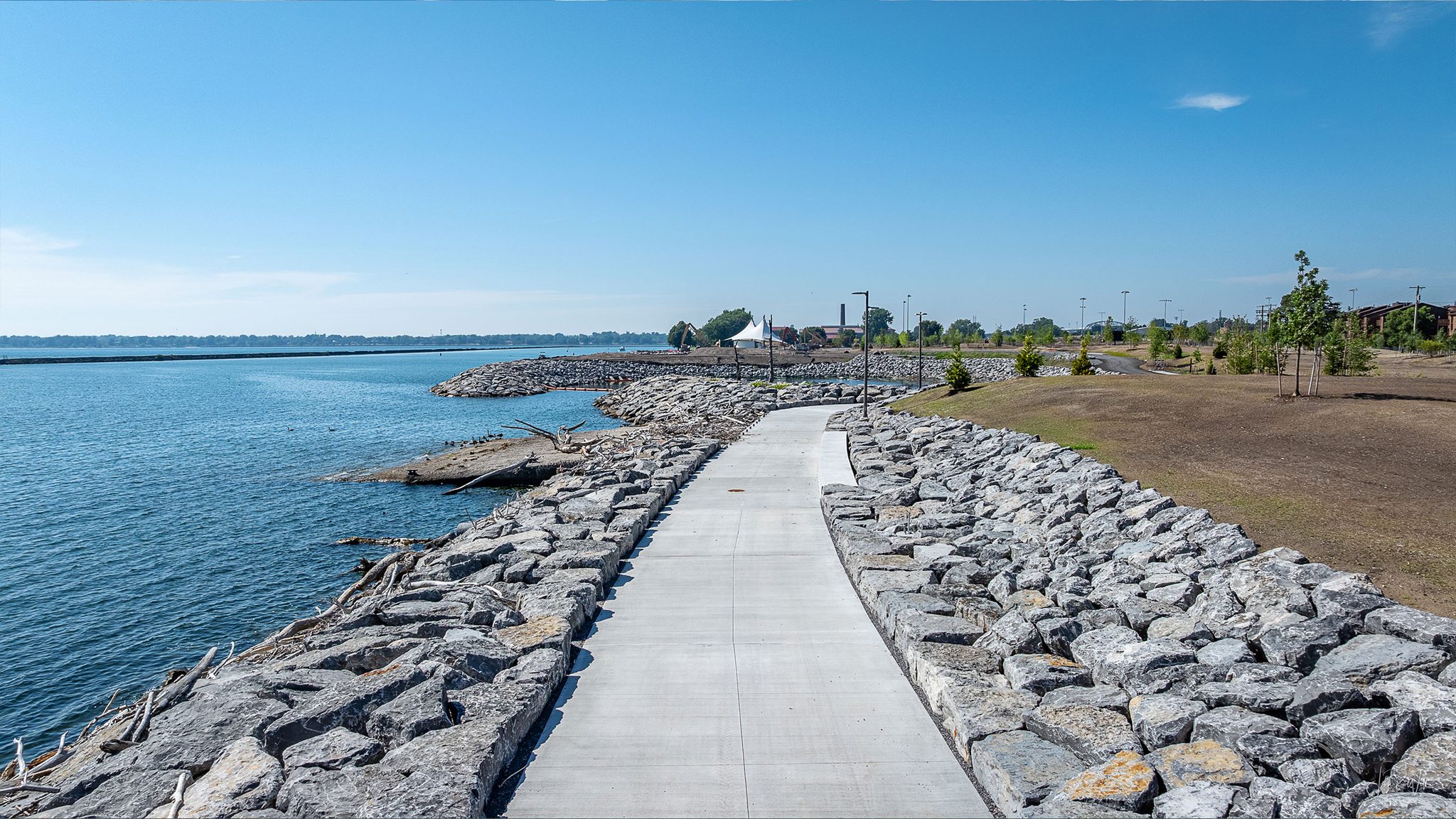
Their strategy was simple: Instead of trying to stop the lake’s power, let the shoreline absorb it.
The team engineered a wavy, curving slope of interlocking stone that diffuses wave energy instead of bouncing it back, with larger stones facing the open lake and smaller ones lining the calmer inlet. Combined with raised ground elevations along the bank, the new design reduces flood risk far more effectively than the concrete wall ever did – earning praise from agencies like the Great Lakes Commission as a benchmark for shoreline restoration.
Most ecological restoration happens in dry conditions, but this project didn’t have that luxury. To keep vegetation from washing away, ecologists used “rock socks” (mesh bags filled with soil and stone) where plants rooted in a nursery for eight weeks before placement. Because building a Great Lakes wetland shoreline is largely uncharted territory, planting was phased over two growing seasons across four plant zones, adjusting species selection based on real-world survival rates.
The Shoreline’s Next Chapter
The ecological team is now five years into monitoring six acres of newly created wildlife habitat, part of the park’s larger 100-acre footprint. The early signs are promising: migratory waterfowl are nesting in the newly established vegetation, and the sheltered inlet gives fish a refuge from the fast currents the old straight wall used to create. Because the site spent decades as a dumping ground before becoming a park, there was no clean historical baseline to restore. Instead, the restoration team created a brand-new ecological foundation tailored specifically to native species, while giving neighbors safe, direct access to the water’s edge.
This project matters beyond Buffalo too. As Great Lakes cities gain attention as climate-resilient places to live, Buffalo now features a waterfront built to absorb major storms rather than resist them until failure. That’s the kind of infrastructure more lakefront and coastal communities will need as extreme weather becomes harder to predict.
A hundred years ago, someone tried to tame Lake Erie with a wall of cement. It took a century, a cold November walk, and a team willing to rethink the whole relationship between a park and its lake. But Ralph Wilson Park’s shoreline now does something that wall never could. It bends with the water instead of fighting it, and that’s better for everyone who calls it home, people and wildlife alike. This new proximity to the water continues the community-centered philosophy that Imagine LaSalle established from the very beginning. Just as local residents helped design a shoreline built to withstand Lake Erie’s power, sustaining it will rely on that same spirit of community stewardship. While the sensitive wetland sanctuary establishes itself, visitors and neighbors will need to continue to act as the true guardians of the park, refraining from climbing or fishing in the wetland area. The same community care that brought this resilient design to life is what will protect and keep this shoreline thriving for generations to come.